
血液腫瘤科/細胞治療中心/台灣細胞免疫醫學會 陳駿逸醫師
多數荷爾蒙受體陽性/HER2陰性之晚期乳癌患者在接受現行荷爾蒙治療合併 CDK4/6 抑制劑後,不可避免地會產生治療抗性,目前二線治療尚無明確標準方針。
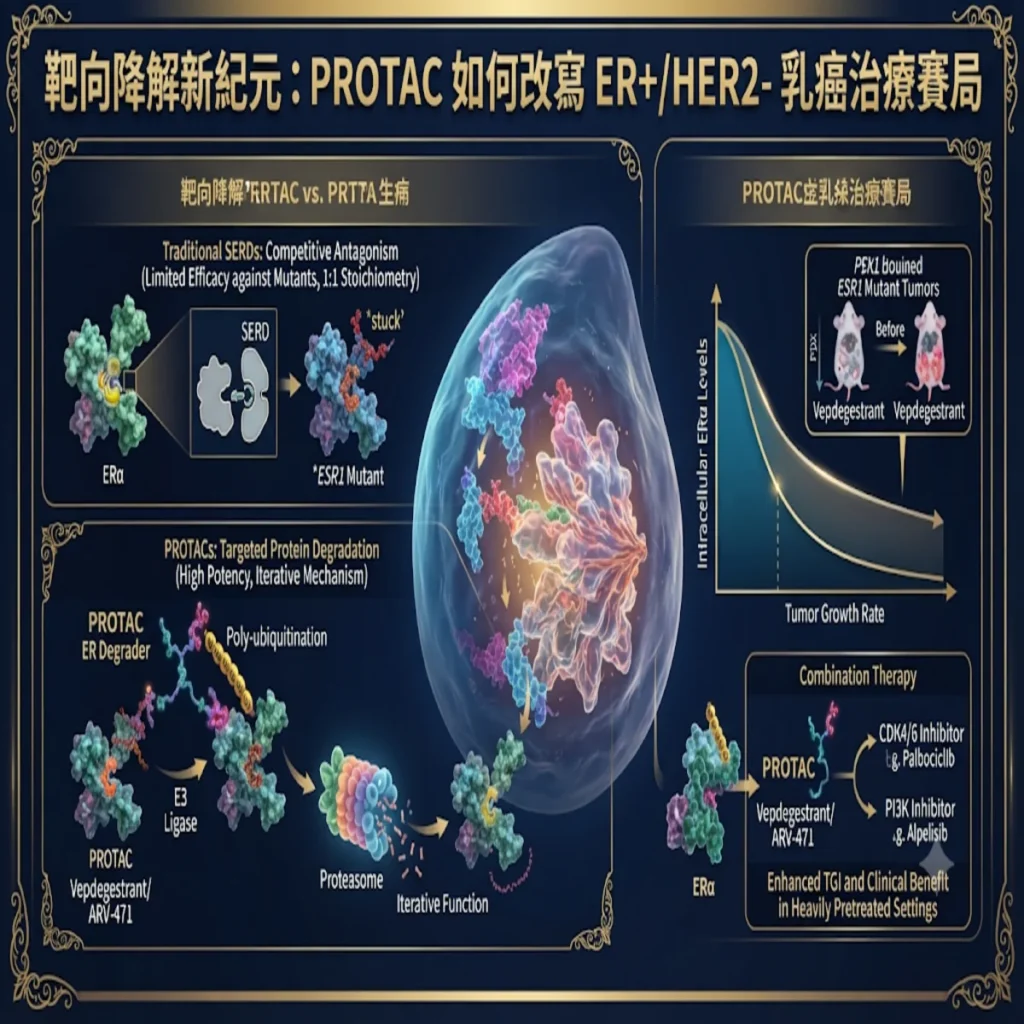
創新突破之PROTAC(PROteolysis TArgeting Chimera),荷爾蒙受體之降解劑作為一種新興藥物,利用細胞內天然的蛋白質清理機制,展現了超越傳統選擇性雌激素受體降解劑(SERD)的治療潛力。
問題背景:球場上的戰術僵局
作為腫瘤科醫師,我們深知在治療荷爾蒙受體陽性/HER2陰性之晚期乳癌時,就像在進行一場激烈的足球賽。我們現有的「主力戰術」是內分泌治療搭配 CDK4/6 抑制劑,這能有效地阻斷癌細胞的生長訊號。然而,比賽進入後半場,癌細胞往往會進化出「變異」來規避防守(例如: ESR1 基因突變),導致治療抗性,這好比防守球員已經熟悉了我們的戰術,導致進攻效率大幅下降。
傳統的藥物(如 SERM、SERD)多採取「一對一」的防守策略,必須佔據受體的配體結合位點才能發揮作用。然而,當癌細胞中受體數量過多或發生突變時,這種「一對一」的防守顯得力不從心,且往往因為藥物依賴結合平衡,難以達到徹底的封鎖效果。
解決方案:PROTAC,球場上的「清道夫」
PROTAC 的出現,為這場戰術僵局帶來了改變。若將癌細胞比喻為一個雜亂的足球場,PROTAC 就是一位配備了「精準導航系統」與「強力清潔工具」的清道夫。
PROTAC 是一種雙功能分子,一端精準鎖定致癌的雌激素受體,另一端則召喚細胞內的 E3 泛素連接酶(E3 ubiquitin ligase)。這就像是將一張「紅色罰單」貼在荷爾蒙受體身上,標記它為「需移除的廢棄物」。
最精妙之處在於,完成任務後的 PROTAC 並不會被消耗掉,而是可以離開現場,繼續去標記下一個荷爾蒙受體。這種循環機制讓其具備了「以一擋百」的能力,徹底清除有害的荷爾蒙受體,而不僅僅是進行競爭性抑制。
目前研發最進展的 vepdegestrant(ARV-471)已在臨床試驗中展現出優於傳統 SERD(如:fulvestrant)的潛力,即使在經歷多線治療的患者中,依然觀察到良好的抗腫瘤活性與安全性,且能有效降解多種 ESR1 突變。
展望未來的黃金陣容
PROTAC之雌激素受體降解劑正迅速成為乳癌治療領域的「明星球員」。與其單打獨鬥,目前的趨勢更傾向於「團隊合作」,即將 vepdegestrant 與 CDK4/6 抑制劑或其他標靶藥物聯用,以期產生加成效應。
隨著 VERITAC-2 等大型三期臨床試驗數據的成熟,我們期待這些新穎藥物能早日成為臨床治療的標準基石,為荷爾蒙受體陽性之晚期乳癌患者提供更持久的「比賽」續航力,改寫治療抗性的比賽規則。
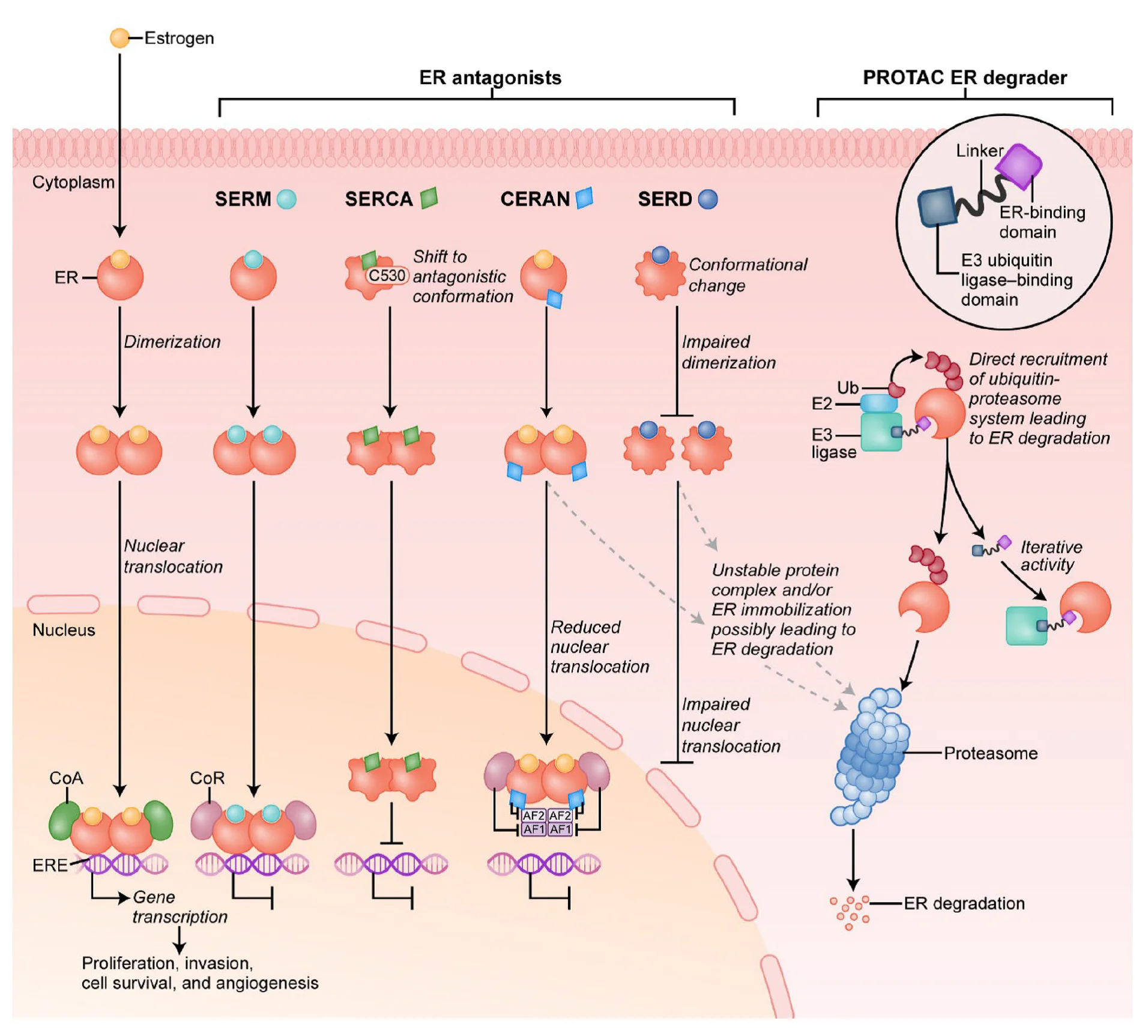
MOAs of ER-targeting therapies in breast cancer. A video showing the MOA of ER antagonists and PROTAC ER degraders is available in the online version of the article. The slide deck is available in the Electronic Supplementary Material. Binding of estrogen to ER promotes ER dimerization, subsequent translocation to the nucleus, and activation of genes regulating cell growth, proliferation, and survival . SERMs (e.g., tamoxifen and lasofoxifene) competitively bind ER, leading to tissue-dependent antagonistic or agonistic effects. In breast tissue, this SERM-receptor complex may allow recruitment of corepressors that result in estrogen antagonist activity. SERCAs (e.g., H3B-6545) covalently bind to a cystine residue (C530) in the ligand-binding pocket of ER, effectively locking ER into a unique antagonistic conformation that blocks transcription without inducing ER degradation. CERANs (e.g., palazestrant [OP-1250]) block ER activity by binding directly to the AF2 transcription activation domain and by potentially recruiting nuclear receptor corepressors to inactivate the AF1 transcription activation domain; CERANs can also act like SERDs and indirectly induce ER degradation. SERDs (e.g., fulvestrant and elacestrant) are competitive antagonists of ER; upon binding, the side chain of the SERD induces a conformational change in ER that impairs receptor dimerization and nuclear translocation and can indirectly induce ER degradation by the proteasome through the creation of an unstable protein complex. Some studies showed that ER degradation is not required for SERD activity, suggesting that ER immobilization may drive the inhibition of ER-mediated transcription by SERDs, with degradation as a secondary effect. PROTAC ER degraders (e.g., vepdegestrant) are bifunctional small molecules containing an ER-binding domain and an E3 ubiquitin ligase–binding domain joined by a linker. In cells, PROTAC ER degraders create a trimer complex with the target protein and an E3 ligase, resulting in the formation of a ubiquitin chain on ER. The polyubiquitinated ER is subsequently recognized and degraded by the proteasome. After inducing ubiquitination, PROTACs are released from the trimer complex and can bind to and trigger the ubiquitination of additional molecules of the target protein, demonstrating an iterative MOA
參考文獻:
PROteolysis TArgeting Chimera (PROTAC) Estrogen Receptor Degraders for Treatment of Estrogen Receptor–Positive Advanced Breast Cancer
Target Oncol. 2025 May;20(3):431-444
#乳癌治療
#腫瘤醫學
#精準醫療
#PROTAC
#Vepdegestrant
#癌症研究
#HER2negative
#醫學突破
#臨床試驗
陳駿逸醫師醫療門診服務時段
https://mycancerfree.com/contact/
更多陳駿逸醫師的癌症衛教影片請連接https://www.youtube.com/@mycancerfree
更多腫瘤治療相關資訊 請連接”陳駿逸醫師 與你癌歸於好” https://mycancerfree.com